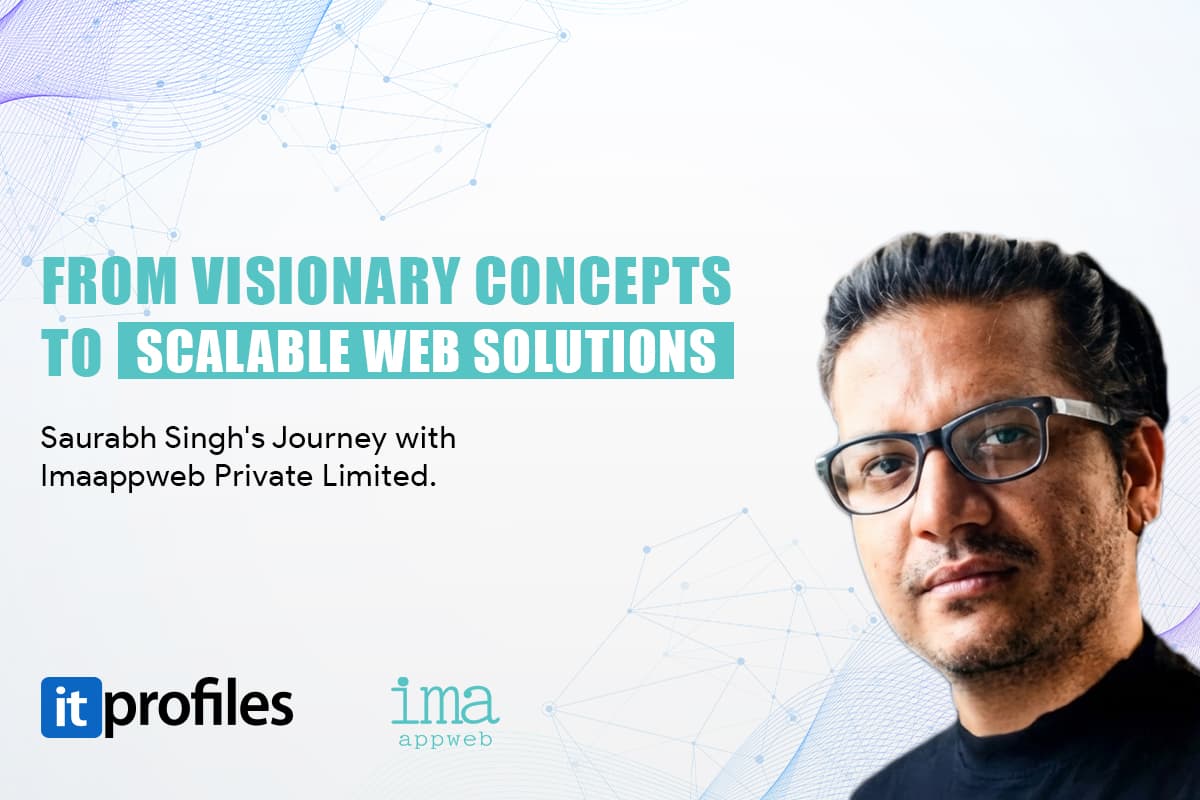
Engineering the Intelligence Era: An Exclusive Conversation with Saurabh Singh, Founder of Ima Appweb Private Limited
BY Ima Appweb ON May 1, 2026
In an exclusive conversation with ITProfiles, Saurabh Singh, Founder of Ima Appweb Private Limited, discusses how artificial intelligence is reshaping clients' fundamental expectations of technology partners today. As the market becomes flooded with automated content and "pattern-averaged" code, the dynamic has shifted; sophisticated clients are no longer looking for mere execution, but for the architecture and accountability that AI alone cannot provide.
Singh explains that while the ubiquity of AI tools is a positive step for efficiency, it has created a dangerous "Accountability Gap." Many now underestimate the complexities of real-world implementation, assuming that a software subscription can replace deep technical judgment. In this interview, Saurabh reflects on how Ima Appweb Private Limited balances these expectations by moving beyond the "bot-first" hype to focus on Technical Intelligence, the transition from legacy service lists to data-driven, resilient ecosystems.
This ITProfiles exclusive sheds light on a critical truth for the next frontier of tech: in an era where execution has become a cheap commodity, the "human edge" is the new premium. Success in this landscape depends on mastering System Thinking, the human ability to connect product, data, and infrastructure into a coherent whole that can withstand the unpredictable pressures of the real world.
The Accountability Gap: Why Systems Trump Tools in an AI-Driven World
In an era where $20 AI tools are ubiquitous, the question of why sophisticated clients continue to invest in high-level human teams is more relevant than ever. For Saurabh Singh, the answer lies in a fundamental distinction: “Tools don’t solve problems, systems do.” While AI can churn out content or code at a low cost, smart clients are actually looking for architecture, reliability, and accountability. These are core qualities that a simple software subscription simply cannot offer to a growing business.
At Ima Appweb Private Limited, the value proposition is built on the reality that clients aren’t just buying “content” or “code” anymore. Instead, “They’re buying architecture, reliability, and accountability,” which ensures the long-term health of their digital ecosystem.
When technology breaks at scale, there isn’t a chatbot available to step in and fix the fallout or manage the crisis. Saurabh emphasizes this point by noting, “When something breaks at scale, there’s no chatbot taking responsibility. We do.”
Beyond the Ideal Path: Solving for Real-World Context and Edge Cases
The shift toward relying on purely automated builds often leads to a recurring pattern of failure that Saurabh has witnessed firsthand. In several instances where clients sought a rescue for failed automated projects, the consistent breaking point was always a lack of context.
Saurabh observes that “AI can generate pieces, but it can’t maintain deep business context across systems, edge cases, and evolving software development requirements.” Without that birds-eye view, the individual parts of a project fail to work together as a cohesive whole.
One specific project collapsed because the AI-built workflow was designed for a "perfect" scenario that rarely exists in the wild. It simply couldn’t handle the messy reality of partial failures, inconsistent data, or non-linear user behavior that wasn't "ideal."
This highlights the vital role of human engineering at Ima Appweb Private Limited in building robust systems. As Saurabh explains, “That’s where human engineering matters,” ensuring that technology can thrive even amidst the unpredictable exceptions of the real world.
The Human Element: Turning Uncertainty into Trust Through Radical Transparency
When a project hits a major technical wall, the difference between a high-level partnership and a basic transaction becomes clear. Saurabh believes that the root of client anxiety in these moments isn't actually the technical bug itself, but rather the psychological void left by a lack of communication.
“Clients don’t panic because of technical issues, they panic because of uncertainty,” he explains. While a bot might be programmed to simulate a soothing tone, it fundamentally lacks the ability to offer genuine reassurance during a crisis.
At Ima Appweb Private Limited, the team defines empathy as a proactive combination of clarity and ownership. They remove the "unknowns" by being radically transparent about what broke, why it happened, and exactly what the next steps are to resolve the issue.
This level of accountability is something an automated system simply cannot replicate. As Saurabh puts it, “Bots can simulate tone, but they can’t take responsibility under pressure.” This human-led transparency is what keeps clients calm and trusting when things get difficult.
Augmentation Over Replacement: Redefining the Premium Signal in Tech
The conversation around "100% human" strategy is often compared to the "Organic" or "Handmade" labels found in other industries, suggesting a return to traditional methods. However, Saurabh views this shift through a more nuanced lens, noting that the label itself isn't the ultimate goal.
“Not exactly. ‘100% human’ isn’t the goal, correct human intervention is,” he explains, shifting the focus from the absence of tools to the presence of expertise. In the current landscape, the most effective teams aren't those avoiding new technology, but those that have mastered the balance of man and machine.
Saurabh believes that the industry is moving toward a standard where “The best teams are AI-augmented, not AI-replaced.” The premium signal to look for isn't a claim that no AI was used; rather, “It’s ‘we know exactly where AI should and shouldn’t be used,’” according to Saurabh.
Architecting Resilience: The Power of System Thinking in the Next Frontier
As we look toward the next year of technological disruption, the focus at Ima Appweb Private Limited is shifting toward a skill that no algorithm has yet mastered. For Saurabh, the one human capability they are doubling down on to remain irreplaceable is the art of system thinking.
“AI can optimize parts, but it still struggles to design resilient, end-to-end systems that work in the real world,” he observes. This high-level skill involves the ability to see the forest and the trees simultaneously. It requires a deep understanding of how to connect product, data, infrastructure, and business goals into one coherent, functioning system.
Saurabh explains that while these models are impressive, they lack the ground-level understanding of business logic and user intent that is essential for architecting high-performance digital platforms.
Cutting Through the Noise: Why Originality is the New Premium
In a digital landscape where everyone is using AI to automate emails and blogs, the space has become incredibly crowded. Saurabh notices that most AI-generated content sounds remarkably similar because it is essentially "pattern-averaged."
“We don’t outsource thinking to AI,” he asserts. While the technology helps with the initial drafting, the core perspective remains strictly human. To maintain this unique voice at scale, Ima Appweb Private Limited employs sophisticated technical strategies beyond simple prompting.
They develop RAG (Retrieval-Augmented Generation) systems and train models on specific company data. “We feed the model with business branding to let it know about voice and tone,” Saurabh notes. By combining deep technical training with human oversight, they ensure their communication reflects a genuine personality.
The Art of the Trade-Off: Why AI Struggles with High-Stakes Decision Making
A growing trend in the industry is for teams to lean too heavily on automation, letting bots do 100% of the thinking. However, Saurabh points out that this leads to a massive gap in judgment. “In real projects, you’re constantly balancing speed, cost, scalability, and risk,” he explains.
There is rarely a single "correct" path in high-level engineering; instead, there are only informed decisions made by professionals. Saurabh notes that “There’s no ‘correct’ answer, only informed decisions,” a reality that requires a human touch.
The fundamental limitation of current technology is its inability to grasp the weight of a choice. At Ima Appweb Private Limited, the team understands that “AI doesn’t truly understand consequences; it just predicts patterns.” By keeping humans at the center, the agency ensures that every trade-off is made with the client's long-term business health in mind.
Compressed Experience: The Founder’s Instinct in an Ambiguous Market
The debate between data-driven logic and "gut feeling" is a central theme in modern leadership. Saurabh views intuition as the result of years of immersion in the industry. “Intuition is compressed experience,” he explains, noting that it is built by seeing patterns across countless failures and successes over time.
While AI models are excellent at approximating patterns, they lack ownership. As Saurabh puts it, “AI can approximate patterns, but it doesn’t own outcomes, so its ‘intuition’ has no stakes.”
This lack of "skin in the game" is why founder instinct remains the ultimate USP when decisions are ambiguous and high-risk. However, the agency is looking to bridge this gap. “Upcoming time, we are working on AI model training which thinks like a founder,” Saurabh reveals.
The Value of Judgment: Why Strategic Execution is the New Luxury
The market is reaching a point of saturation where "cheap" AI-led work is increasingly viewed as a basic commodity. Saurabh observes that as the cost of production drops, the market's focus is shifting toward a much rarer resource: judgment.
“Execution is cheap now, judgment isn’t,” he notes, highlighting that the ability to perform a task is no longer the primary value driver. In a world where anyone can generate a deliverable, the true differentiation lies in the "why" and the "how."
Saurabh believes that “Very few can decide what should be built, why, and how it scales,” and it is this scarcity of high-level oversight that justifies the premium investment. “That decision layer is where most value (and risk) sits,” Saurabh explains, reinforcing why human-led strategy has become the definitive high-end service.
The Great Stratification: Finding the Balance Between Automation and Human Oversight
The debate over whether we will see a widespread "back to humans" movement suggests a binary choice. However, Saurabh anticipates a more nuanced evolution. “There won’t be a full ‘back to humans’ shift,” he predicts.
Instead, the industry is entering a phase of stratification where commodity interactions go to bots, while “high-stakes, complex decisions stay with humans.” The real winners will be those who can integrate both forces without losing their souls, especially in high-stakes mobile app development projects.
“The real winners will be teams that know how to combine both without confusing the two,” Saurabh notes. By avoiding the confusion between what can be automated and what requires a human spirit, Ima Appweb Private Limited ensures that while technology provides the foundation, human strategy provides the direction
Frequently Asked Questions About Engineering the Intelligence Era
1. What is the role of human intelligence in the age of artificial intelligence?
Human intelligence remains essential in the age of artificial intelligence because businesses need strategic thinking, contextual understanding, ethical judgment, and accountability. While AI can automate tasks and generate solutions, human experts evaluate risks, manage complex situations, and align technology with business objectives to build reliable, scalable, and sustainable digital systems.
2. Why is system thinking important in AI-driven software engineering?
System thinking is important in AI-driven software engineering because it considers how applications, databases, APIs, infrastructure, and business processes work together. Instead of optimizing individual components, engineers evaluate the entire ecosystem. This approach helps identify dependencies, prevent integration failures, improve resilience, and create software systems that perform reliably under real-world conditions.
3. Can AI replace human software engineers and developers?
AI can automate several software development tasks, including code generation, testing assistance, documentation, and debugging. However, human engineers remain important for architectural decisions, complex problem-solving, security assessment, and business-specific requirements. The most effective approach combines AI-powered productivity with human expertise, enabling development teams to deliver reliable software while maintaining accountability.
4. What is the accountability gap in AI-powered software development?
The accountability gap in AI-powered software development occurs when organizations rely on automated tools without clearly assigning responsibility for the resulting systems. AI-generated solutions may overlook business context, integration dependencies, or exceptional scenarios. Experienced engineering teams help close this gap through testing, architectural oversight, risk management, and ownership of production outcomes.
5. How can businesses build reliable AI-powered software systems?
Businesses can build reliable AI-powered software systems by defining clear requirements, selecting appropriate architectures, validating AI-generated outputs, and testing real-world scenarios. They should also implement monitoring, security controls, error handling, and human oversight. Combining AI capabilities with disciplined engineering practices helps organizations improve scalability, maintainability, and operational reliability.
6. Why is human judgment important when implementing artificial intelligence?
Human judgment is important when implementing artificial intelligence because business decisions often involve competing priorities, including cost, speed, scalability, security, and long-term risk. AI can provide recommendations and analyze information, but experienced professionals must evaluate trade-offs, understand consequences, and choose solutions that align with organizational goals and customer needs.
7. How can businesses balance AI automation with human oversight?
Businesses can balance AI automation with human oversight by automating repetitive, predictable tasks while reserving complex, sensitive, and high-impact decisions for qualified professionals. Clear escalation procedures, output validation, performance monitoring, and defined responsibilities help maintain control. This approach improves efficiency without sacrificing decision quality, transparency, or accountability.
8. What is Retrieval-Augmented Generation (RAG), and how does it improve AI-generated content?
Retrieval-Augmented Generation (RAG) is an AI technique that retrieves relevant information from trusted data sources before generating a response. It helps AI systems produce more context-aware answers grounded in organizational knowledge. When implemented properly, RAG can improve relevance, support brand consistency, and reduce unsupported responses, although it does not eliminate errors.
9. Why are strategic thinking and technical expertise valuable in AI development?
Strategic thinking and technical expertise are valuable in AI development because successful projects require more than generating code or automating tasks. Teams must understand business objectives, evaluate technical constraints, manage integration challenges, and anticipate risks. These capabilities help organizations select appropriate technologies, prioritize investments, and develop solutions that deliver meaningful business outcomes.
10. What is the future of software engineering in the AI era?
The future of software engineering will increasingly combine AI-assisted development with human-led architecture, strategic decision-making, and quality assurance. Developers will use AI to accelerate routine tasks while focusing more on system design, security, integration, and complex problem-solving. Professionals who combine technical expertise, AI literacy, and critical thinking will be well positioned for this evolving industry.